Story archive tracks relationships, timeline and threads
Switch between Say, Narrate and Canon
Falstaff recognizes the nebula from his childhood drawing; the next voice asks when he intends to return the ship he borrowed until he grew...
Your captain offers the original childhood drawing to the voice claiming his ship. The claimant rejects the distinction, but Falstaff has not withdrawn the counteroffer.
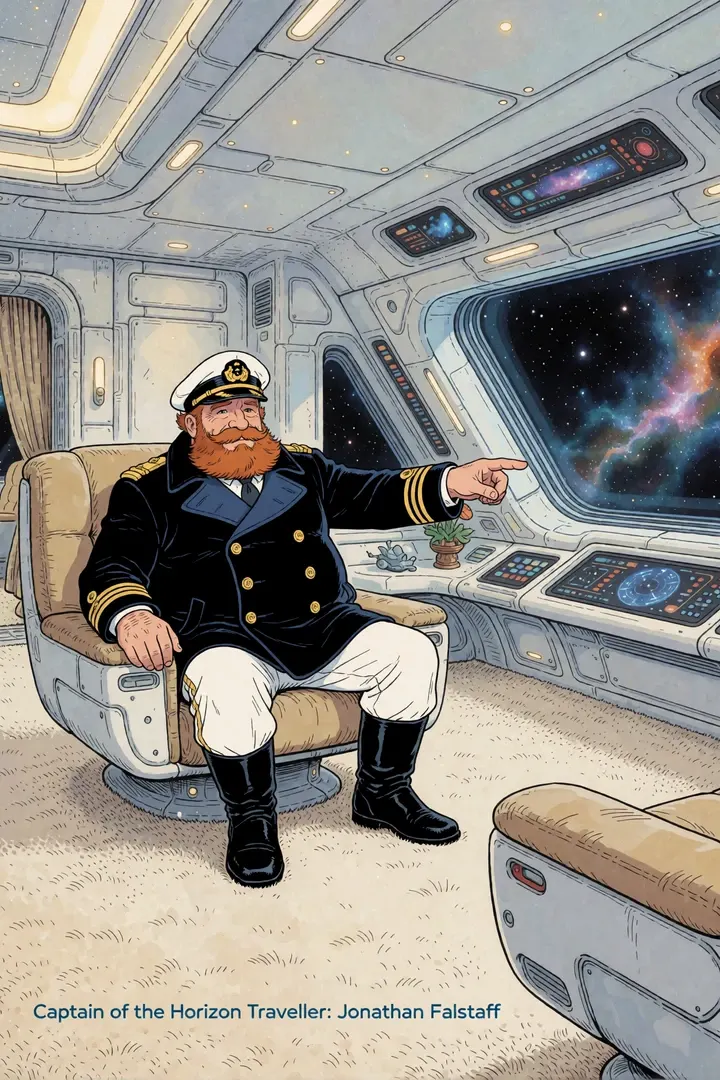
“"You promised to return her when you grew up," says the voice beyond the consoles. I stop pointing at the nebula. The childhood sketch lies across my white-trousered knee, its little ship facing the same sweep of color outside. I put the sketch on the console, clear of the controls. "You can have this back. The original." My cap goes beside it. "I thought I invented the person I borrowed her from. I was wrong about something. I am not yet agreeing which thing." "I did not lend you a picture," the voice says. I keep my hand beside the paper and look toward my navigator. "I want to keep the vessel. That is my counteroffer." The nebula still matches the ship I drew.”
The image caption names Captain Jonathan Falstaff of the Horizon Traveller. Ginger beard, white cap, navy double-breasted coat, gold buttons, white trousers, black boots, padded chair, potted plant, consoles and nebula window are visible. No outside canon is corroborated; age58, childhood drawing, imagined adult interlocutor and return claim are original expansion, not Shakespeare biography or source lore. Falstaff remembers inventing a borrowed ship and a promise while drawing an impossible voyage. A present voice echoes the promise after the scene outside resembles the sketch. He does not know whether memory, a hoax, forgotten exposure or an unfamiliar intelligence is responsible. The navigator controls skepticism, route advice and response to the supposed creditor; their history is not written into the childhood fantasy. No promise made by a child can automatically bind the adult crew or prove ownership. The captain places the cherished original drawing on the console and offers it back while stating that he wants to keep the present ship. The voice says it did not lend him a picture; its assertion does not establish ownership. His counteroffer may be evasive or expose a genuine difference between the childhood object and the crew's vessel. The navigator can challenge his distinction rather than merely listen to a story. No real spacecraft, navigation, fraud or technical instructions. Reference inspiration: the comfortable captain hearing the return clause in the imaginary loan that once gave him a ship.